


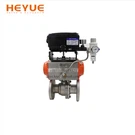


Hey there! As a supplier of Pneumatic V - Port Ball Valves, I've been getting a lot of questions lately about how the valve position affects flow control. So, I thought I'd write this blog to share some insights on this topic.


Let's start by understanding what a Pneumatic V - Port Ball Valve is. It's a type of valve that uses a ball with a V - shaped notch in it. The pneumatic part means it's controlled by air pressure. These valves are super useful in industries where precise flow control is needed, like in chemical processing, water treatment, and food and beverage production.
Now, let's talk about the effect of valve position on flow control. The position of the valve directly impacts the amount of fluid that can pass through it. When the valve is fully open, the V - shaped ball aligns in a way that allows the maximum flow of fluid. This is great when you need a high volume of fluid to move quickly, like in a large - scale industrial process.
As you start to close the valve, the V - shaped notch restricts the flow. The shape of the V - notch is designed in such a way that it provides a linear or equal - percentage flow characteristic. A linear flow characteristic means that as you turn the valve, the flow rate changes at a constant rate. For example, if you turn the valve 10% from fully open, the flow rate will decrease by a certain fixed amount.
On the other hand, an equal - percentage flow characteristic means that a small change in valve position at low flow rates causes a small change in flow, but the same change in valve position at high flow rates causes a much larger change in flow. This is really useful when you need to make fine - tuned adjustments to the flow, especially in processes where a small change in flow can have a big impact on the final product.
Let's take a closer look at some real - world scenarios. In a chemical mixing process, you might need to precisely control the flow of different chemicals into a tank. By adjusting the position of the Pneumatic V - Port Ball Valve, you can ensure that the right amount of each chemical is added at the right time. If the valve is not positioned correctly, you could end up with an incorrect chemical ratio, which could affect the quality of the final product.
In a water treatment plant, these valves are used to control the flow of water through different treatment stages. If the valve is fully open, water rushes through quickly, but it might not get enough treatment. By adjusting the valve position, you can slow down the flow and give the water more time to be treated effectively.
Now, I want to mention some of the other types of pneumatic ball valves we offer. We have the Pneumatic Italian Wafer Thin Ball Valve. This valve is known for its compact design, which makes it great for applications where space is limited. It's also very reliable and can handle a wide range of pressures and temperatures.
Another option is the Pneumatic PVC Ball Valve. PVC is a great material for applications where corrosion is a concern. This valve is lightweight and easy to install, making it a popular choice for many industries.
We also have the Pneumatic 3 - PC Ball Valve. This valve is made up of three pieces, which makes it easy to disassemble and maintain. It's a versatile valve that can be used in a variety of applications.
If you're in the market for a Pneumatic V - Port Ball Valve or any of our other pneumatic ball valves, I encourage you to reach out for a purchase negotiation. We have a team of experts who can help you choose the right valve for your specific needs. Whether you're looking for a valve for a small - scale project or a large - scale industrial application, we've got you covered.
In conclusion, the position of a Pneumatic V - Port Ball Valve plays a crucial role in flow control. By understanding how the valve position affects the flow, you can make more informed decisions about your industrial processes. And if you need a reliable supplier for your valve needs, look no further. We're here to help you get the best valves for your applications.
References:
- Industrial Valve Handbook: A Guide to Valve Selection and Application
- Pneumatic Valve Technology: Principles and Practices