

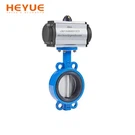


Hey there! As a supplier of Pneumatic Lug Butterfly Valves, I'm super stoked to chat with you about all the cool accessories you can pair with these valves. Our Pneumatic Lug Butterfly Valves are already top - notch in the industry, but with the right accessories, their performance can skyrocket.
Positioners
Let's kick things off with positioners. These little guys are like the brain behind the valve's operation. A positioner makes sure the valve opens and closes exactly the way you want it to. It takes the control signal from your system and adjusts the valve's position accordingly. This is especially useful when you need precise control over the flow rate. For instance, in chemical processing plants, where even a tiny deviation in the flow can mess up the entire production process, a positioner ensures that the Pneumatic Lug Butterfly Valve maintains the right opening percentage. There are different types of positioners too. You've got analog positioners, which are great for basic control needs, and digital positioners, which offer more advanced features like self - diagnostics and communication capabilities. If you're looking for high - end control, digital positioners are the way to go. They can communicate with your control system via protocols like HART or Profibus, giving you real - time data on the valve's status.
Limit Switches
Next up are limit switches. Think of limit switches as the valve's safety guards. They tell you when the valve is fully open or fully closed. This is crucial for a couple of reasons. First, it helps in preventing over - travel of the valve, which can damage the valve and its components over time. Second, it provides feedback to your control system. For example, in an automated pipeline system, the control system needs to know the exact position of the valve to manage the flow effectively. Limit switches can be either mechanical or proximity - based. Mechanical limit switches work by physically making contact with a part of the valve when it reaches the open or closed position. Proximity limit switches, on the other hand, use magnetic or inductive sensors to detect the valve's position without any physical contact. This makes them more durable and less prone to wear and tear.
Solenoid Valves
Solenoid valves are another must - have accessory for Pneumatic Lug Butterfly Valves. These valves control the flow of air to the pneumatic actuator of the butterfly valve. They work by using an electromagnetic coil to open or close a small valve, which in turn controls the air pressure. Solenoid valves are incredibly fast - acting, which means they can quickly change the state of the pneumatic actuator. This is great for applications where you need rapid opening and closing of the valve, like in emergency shut - off systems. You can choose from different types of solenoid valves based on your requirements. For example, 2 - way solenoid valves are used for simple on/off control, while 3 - way and 4 - way solenoid valves offer more complex control options.
Air Filter Regulators
Air filter regulators are essential for maintaining the health of your Pneumatic Lug Butterfly Valve. The pneumatic actuator of the valve relies on clean and regulated air to function properly. Air filter regulators do two main jobs: they filter out any dirt, dust, or moisture from the compressed air, and they regulate the air pressure to a consistent level. If the compressed air is dirty, it can cause abrasion inside the actuator, leading to reduced performance and a shorter lifespan. On the other hand, inconsistent air pressure can make the valve operate erratically. So, having a good air filter regulator is like giving your valve a long - life insurance policy.
Handwheels
Now, handwheels might not seem as high - tech as some of the other accessories, but they're incredibly useful. A handwheel provides a manual override option for your Pneumatic Lug Butterfly Valve. In case of a power failure or a problem with the pneumatic system, you can use the handwheel to open or close the valve. This is a great safety feature, especially in critical applications where you can't afford to have the valve stuck in an unwanted position. Handwheels are also handy during maintenance and testing. You can easily adjust the valve's position manually to check its operation without relying on the pneumatic system.
Locking Devices
Locking devices are important for security and safety reasons. They prevent unauthorized operation of the valve. You can use locking devices to keep the valve in a specific position, whether it's fully open, fully closed, or somewhere in between. This is particularly useful in industrial settings where there are strict safety regulations. For example, in a water treatment plant, you might want to lock the valve in a certain position to ensure a consistent flow of water through the treatment process. There are different types of locking devices available, such as padlocks, key - operated locks, and combination locks. You can choose the one that best suits your security needs.
Pneumatic Actuators
Of course, we can't talk about accessories for Pneumatic Lug Butterfly Valves without mentioning pneumatic actuators themselves. The actuator is what makes the valve move. It converts the energy from compressed air into mechanical motion to open and close the valve. There are two main types of pneumatic actuators: double - acting and spring - return. Double - acting actuators use compressed air to both open and close the valve, while spring - return actuators use compressed air to open the valve and a spring to close it. The choice between the two depends on your application. For example, in applications where you need a fail - safe position, a spring - return actuator is a better option. If the air supply fails, the spring will automatically close the valve.
Other Related Products
If you're interested in other types of pneumatic butterfly valves, we also offer Pneumatic Wafer Butterfly Valve, Pneumatic Sanitary Butterfly Valve, and Pneumatic Ventilation Flange Butterfly Valve. Each of these valves has its own unique features and is suitable for different applications.
So, there you have it! A whole bunch of accessories that can take your Pneumatic Lug Butterfly Valve to the next level. Whether you need precise control, safety features, or just a backup option, these accessories have got you covered. If you're looking to upgrade your valve system or start a new project, I'd love to talk to you. Reach out to us to discuss your specific requirements and let's figure out the best combination of the valve and its accessories for you. Let's work together to make your valve operation as efficient and reliable as possible.
References


- Various industry manuals on pneumatic valve accessories
- Technical documents from valve manufacturers