


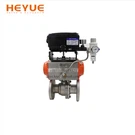


Setting the control parameters of a Quarter Turn Electric Actuator is a crucial task that directly impacts its performance, efficiency, and safety. As a supplier of Quarter Turn Electric Actuators, I understand the significance of providing clear guidance on this topic to our customers. In this blog, I will share some key steps and considerations for setting the control parameters of these actuators.
Understanding the Basics of Quarter Turn Electric Actuators
Before delving into parameter setting, it's essential to have a basic understanding of Quarter Turn Electric Actuators. These actuators are designed to rotate a valve or other device through a 90-degree angle, which is commonly used for ball valves, butterfly valves, and dampers. They offer precise control, high torque output, and can be integrated into various control systems.
Step 1: Determine the Application Requirements
The first step in setting the control parameters is to understand the specific requirements of the application. This includes factors such as the type of valve or device being operated, the required operating speed, the torque needed to open and close the valve, and the environmental conditions.
- Valve Type: Different types of valves have different torque requirements and operating characteristics. For example, a ball valve may require a higher torque to overcome the initial friction, while a butterfly valve may have a more linear torque curve.
- Operating Speed: The speed at which the actuator needs to open or close the valve depends on the process requirements. Some applications may require a fast response time, while others may allow for a slower operation.
- Torque Requirements: Calculating the torque required to operate the valve is crucial. This includes considering factors such as the valve size, pressure differential, and friction. Our actuators are designed to provide a range of torque outputs, and selecting the appropriate one is essential for optimal performance.
- Environmental Conditions: The operating environment can also affect the actuator's performance. Factors such as temperature, humidity, and the presence of corrosive substances need to be considered when setting the parameters.
Step 2: Select the Control Mode
Quarter Turn Electric Actuators can be controlled in various modes, including on/off control, proportional control, and modulating control.


- On/Off Control: This is the simplest control mode, where the actuator is either fully open or fully closed. It is commonly used in applications where a binary control signal is sufficient, such as in simple on/off valves.
- Proportional Control: In proportional control, the actuator position is proportional to the control signal. This mode is suitable for applications where a more precise control of the valve position is required, such as in flow control systems.
- Modulating Control: Modulating control is used for applications that require continuous adjustment of the valve position. It allows for fine-tuning of the process parameters and is commonly used in applications such as temperature control and pressure control.
Step 3: Set the Torque Limit
Setting the torque limit is an important safety feature that prevents the actuator from applying excessive torque to the valve. This helps to protect the valve and the actuator from damage.
- Determine the Maximum Torque: Based on the valve's requirements, determine the maximum torque that the actuator should apply. This value should be set slightly higher than the normal operating torque to account for any unexpected resistance.
- Adjust the Torque Limit Setting: Most Quarter Turn Electric Actuators allow for the adjustment of the torque limit. This can usually be done through a control panel or a programming interface. Follow the manufacturer's instructions to set the torque limit accurately.
Step 4: Set the Position Limit
The position limit setting defines the maximum and minimum positions that the actuator can reach. This ensures that the valve is fully open or fully closed and prevents over-travel.
- Determine the Open and Closed Positions: Identify the exact positions where the valve should be fully open and fully closed. This can be done by manually operating the valve and marking the positions.
- Adjust the Position Limit Switches: Most actuators are equipped with position limit switches that can be adjusted to set the open and closed positions. Use a screwdriver or other appropriate tool to adjust the switches according to the marked positions.
Step 5: Configure the Control Signal
The control signal is used to communicate with the actuator and control its operation. The type of control signal depends on the control mode selected.
- Analog Control Signal: For proportional and modulating control, an analog control signal is typically used. This can be a current signal (e.g., 4-20 mA) or a voltage signal (e.g., 0-10 V). Configure the actuator to accept the appropriate control signal and adjust the signal range as needed.
- Digital Control Signal: For on/off control, a digital control signal can be used. This can be a simple on/off switch or a digital input from a control system. Connect the control signal to the appropriate input terminals on the actuator and configure the settings accordingly.
Step 6: Test and Fine-Tune the Parameters
Once all the parameters have been set, it's important to test the actuator to ensure that it is operating correctly.
- Initial Testing: Perform a basic test by manually operating the actuator and checking the valve's opening and closing positions. Make sure that the torque limit and position limit settings are working correctly.
- System Integration Testing: If the actuator is being integrated into a larger control system, perform a system integration test to ensure that the actuator responds correctly to the control signals. Monitor the process parameters and make any necessary adjustments to the control parameters.
- Fine-Tuning: Based on the test results, fine-tune the control parameters as needed. This may involve adjusting the torque limit, position limit, or control signal settings to achieve the desired performance.
Additional Considerations
- Safety Features: In addition to torque and position limits, our Quarter Turn Electric Actuators are equipped with other safety features such as overheat protection, short-circuit protection, and emergency stop buttons. Make sure to familiarize yourself with these features and ensure that they are properly configured.
- Maintenance and Calibration: Regular maintenance and calibration of the actuator are essential to ensure its long-term performance and reliability. Follow the manufacturer's recommended maintenance schedule and perform any necessary calibration procedures.
- Technical Support: If you encounter any difficulties or have questions about setting the control parameters, our technical support team is available to assist you. We can provide guidance, troubleshooting tips, and remote support if needed.
Conclusion
Setting the control parameters of a Quarter Turn Electric Actuator requires a thorough understanding of the application requirements, the actuator's capabilities, and the control system. By following the steps outlined in this blog and considering the additional considerations, you can ensure that your actuator is operating at its optimal performance and providing reliable control.
If you are interested in purchasing our Quarter Turn Electric Actuators or need further assistance with parameter setting, please feel free to contact us for a consultation. We also offer a wide range of other electric actuators, including Explosion Proof Electric Actuator, Multi Turn Electric Actuator, and Mini Plastic Electric Actuator. Our team of experts is ready to help you find the right solution for your specific needs.
References
- Manufacturer's documentation for Quarter Turn Electric Actuators
- Industry standards for valve control and electric actuators