


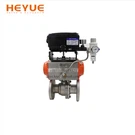

Selecting the appropriate pneumatic actuator for a 3 - way ball valve is a critical decision that can significantly impact the efficiency, reliability, and performance of your industrial processes. As a seasoned Pneumatic 3 - Way Ball Valve supplier, I understand the complexities involved in this selection process and am eager to share some valuable insights.
Understanding the Basics of 3 - Way Ball Valves and Pneumatic Actuators
A 3 - way ball valve is a type of valve that uses a ball with a hole through it to control the flow of fluid or gas. It has three ports, which allows for different flow path configurations, such as L - port and T - port arrangements. These valves are commonly used in a variety of industries, including chemical processing, water treatment, and food and beverage production.
Pneumatic actuators, on the other hand, are devices that use compressed air to operate the valve. They offer several advantages, such as fast operation, high torque output, and reliability in harsh environments. Pneumatic actuators can be either double - acting or spring - return, each with its own unique characteristics.
Factors to Consider When Selecting a Pneumatic Actuator
Torque Requirements
One of the most important factors to consider is the torque required to operate the 3 - way ball valve. The torque needed depends on several factors, including the size of the valve, the pressure of the fluid or gas, and the type of flow path. To determine the correct torque, you need to calculate the seating torque, which is the force required to seat the valve ball against the seats. This can be done using the valve manufacturer's specifications or by consulting a professional engineer.
Actuator Type
As mentioned earlier, there are two main types of pneumatic actuators: double - acting and spring - return. Double - acting actuators use compressed air to both open and close the valve, while spring - return actuators use compressed air to open the valve and a spring to close it. Double - acting actuators are suitable for applications where continuous control is required, while spring - return actuators are often used in safety - critical applications where the valve needs to close automatically in case of a loss of air supply.
Operating Pressure
The operating pressure of the pneumatic actuator must be compatible with the pressure of the system in which the 3 - way ball valve is installed. The actuator should be able to generate enough force to operate the valve at the maximum working pressure of the system. It is important to check the pressure rating of the actuator and ensure that it is higher than the maximum system pressure.
Environmental Conditions
The environmental conditions in which the valve and actuator will be installed should also be taken into account. Factors such as temperature, humidity, and the presence of corrosive substances can affect the performance and lifespan of the actuator. For example, in a high - temperature environment, you may need to choose an actuator with a high - temperature rating. In a corrosive environment, you may need to select an actuator made of corrosion - resistant materials.


Speed of Operation
The speed at which the valve needs to open and close is another important consideration. Some applications require fast - acting valves, while others can tolerate slower operation. The speed of the pneumatic actuator can be adjusted by controlling the air flow rate. You can choose an actuator with adjustable speed settings to meet the specific requirements of your application.
Matching the Actuator with the 3 - Way Ball Valve
Once you have considered all the above factors, you need to ensure that the selected pneumatic actuator is properly matched with the 3 - way ball valve. This includes checking the connection size, type, and orientation. The actuator should be able to fit securely onto the valve and provide the necessary torque to operate it.
In addition, it is important to ensure that the actuator and the valve are compatible in terms of their operating characteristics. For example, if the valve has a high - friction design, you may need to choose an actuator with a higher torque output.
Our Product Offerings
As a Pneumatic 3 - Way Ball Valve supplier, we offer a wide range of high - quality products to meet the diverse needs of our customers. Our Pneumatic 3 - Way Ball Valve is designed for reliable performance and long - term durability. We also provide Pneumatic V - Port Ball Valve and Pneumatic PVC Ball Valve, which are suitable for different applications.
Our team of experts can assist you in selecting the appropriate pneumatic actuator for your 3 - way ball valve. We have in - depth knowledge of the industry and can provide customized solutions based on your specific requirements.
Contact Us for Procurement
If you are in the market for a 3 - way ball valve and a suitable pneumatic actuator, we invite you to contact us for procurement. Our dedicated sales team is ready to answer your questions, provide detailed product information, and discuss your specific needs. We are committed to providing the best products and services to help you achieve optimal performance in your industrial processes.
References
- Valve Handbook, 4th Edition, by Robert W. Miller
- Pneumatic Actuator Design and Application Guide, by Parker Hannifin Corporation
- Industrial Valves: A Guide to Selection, by David W. Green and Norman L. Nadler