

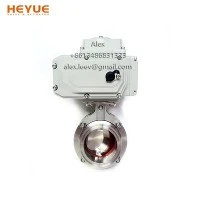



Hey there! I'm a supplier of electric butterfly valves. These valves are pretty cool pieces of equipment in the world of pipeline systems. Let's dive into how they interact with other valves in a pipeline network.
Basics of Electric Butterfly Valves
Before we get into the interaction, let's quickly cover what electric butterfly valves are. They're valves that use an electric actuator to control the position of a disc, which rotates to open or close the valve. This design makes them lightweight, cost - effective, and easy to install. We offer a wide range of them, like the Electric Motorized Sanitary Butterfly Valve, great for food and beverage industries where hygiene is crucial, the Electric Motorized Double Eccentric Butterfly Valve which provides better sealing and reduced friction, and the Electric Motorized Wafer Butterfly Valve that is compact and easy to fit between flanges.
Interaction with Gate Valves
Gate valves are often used in pipelines for on - off service. They have a gate that moves up and down to either allow or block the flow. When an electric butterfly valve works with a gate valve in a pipeline network, they can serve different functions at different times.
For example, in a large - scale industrial water supply pipeline, the gate valve can be used as a main isolation valve. It stays fully open most of the time and is only closed when major maintenance or repairs are needed. The electric butterfly valve, on the other hand, can be used for more frequent flow regulation. It can adjust the flow rate based on real - time demand, such as during peak and off - peak usage periods.
The electric actuator of the butterfly valve allows for quick and precise control. It can receive signals from a control system and adjust the disc position within seconds. The gate valve, being a more robust but slower - acting valve, provides a reliable shut - off when required. So, they complement each other well, with the gate valve handling the long - term isolation and the electric butterfly valve managing the day - to - day flow control.
Interaction with Globe Valves
Globe valves are designed for throttling and regulating the flow. They have a plug that moves up and down against a seat to control the flow rate. When an electric butterfly valve is paired with a globe valve, they can work together to achieve more accurate flow control.
In a chemical processing pipeline, the globe valve can be used for the initial rough adjustment of the flow. It can set a general flow rate based on the process requirements. The electric butterfly valve can then fine - tune the flow. Since it can be controlled precisely by the electric actuator, it can make small adjustments to maintain the exact flow rate needed for the chemical reaction.
The response time of the electric butterfly valve is an advantage here. In a dynamic process where the flow requirements change rapidly, the butterfly valve can quickly adapt. The globe valve, with its better throttling characteristics at low flow rates, still has a role in getting the flow in the right ballpark initially.
Interaction with Check Valves
Check valves are used to prevent backflow in a pipeline. They allow fluid to flow in one direction only. When an electric butterfly valve works with a check valve, the combination can ensure smooth and safe flow in the pipeline.
In a sewage treatment pipeline, the check valve is installed to prevent the sewage from flowing back when the pump stops. The electric butterfly valve can be used to control the overall flow of sewage into the treatment system. When the treatment process requires a certain amount of sewage to enter, the electric butterfly valve opens to the appropriate position. The check valve then ensures that once the sewage has entered the system, it doesn't flow back out.
The electric butterfly valve can also be used in combination with a check valve to manage the pressure in the pipeline. If there is a sudden increase in pressure downstream, the electric butterfly valve can be closed partially or fully to relieve the pressure, while the check valve prevents the backflow of the fluid trying to escape due to the high pressure.
Control and Communication
In modern pipeline networks, valves often need to communicate and work together under the control of a central system. Electric butterfly valves are well - suited for this kind of setup. They can be easily integrated into a control network using various communication protocols like Modbus, Profibus, etc.


The control system can send signals to the electric butterfly valve to adjust its position based on the readings from sensors placed throughout the pipeline. These sensors can measure parameters such as flow rate, pressure, and temperature. The same control system can also send signals to other valves in the network, coordinating their actions.
For example, if a sensor detects a sudden drop in pressure in a pipeline, the control system can send a signal to the electric butterfly valve to open wider to increase the flow and restore the pressure. At the same time, it can also send signals to other valves, like a gate valve or a globe valve, to make appropriate adjustments to ensure the overall stability of the pipeline system.
Challenges and Solutions
Of course, there are some challenges when it comes to the interaction of electric butterfly valves with other valves. One challenge is the potential for interference. If the control signals for different valves are not properly coordinated, it can lead to incorrect valve positions and disrupt the flow in the pipeline.
To solve this problem, proper programming of the control system is essential. The control system should be designed to take into account the characteristics and functions of each valve. For example, it should know the response time of the electric butterfly valve and how it will interact with other slower - acting valves.
Another challenge is the maintenance of the valves. Since different valves have different maintenance requirements, it's important to have a well - planned maintenance schedule. For electric butterfly valves, regular checks of the electric actuator and the disc position are necessary. For gate valves and globe valves, lubrication and inspection of the moving parts are crucial.
Conclusion
In conclusion, electric butterfly valves play an important role in interacting with other valves in a pipeline network. They offer quick and precise control, which can complement the functions of other valves like gate valves, globe valves, and check valves. With proper control and communication systems, they can work together to ensure the efficient and safe operation of the pipeline.
If you're in the market for high - quality electric butterfly valves or want to learn more about how they can interact with your existing pipeline valves, don't hesitate to reach out. We'd be more than happy to discuss your specific needs and help you find the best solutions for your pipeline network.
References
- "Valve Handbook: Principles and Applications", by J. P. Modi
- "Pipeline Engineering and Construction: A Practical Approach", by R. K. Sinha