


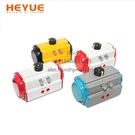
Hey there! As a supplier of pneumatic butterfly valves, I'm super stoked to share with you how these nifty devices work. Pneumatic butterfly valves are widely used in various industries, from water treatment to chemical processing, because they're efficient, reliable, and easy to operate. So, let's dive right in and explore the ins and outs of how a pneumatic butterfly valve operates.
The Basics of a Pneumatic Butterfly Valve
First off, let's get a quick overview of what a pneumatic butterfly valve is. It's a type of quarter - turn valve that uses a disc (the "butterfly") mounted on a rod. When the valve is opened or closed, the disc rotates a quarter - turn (90 degrees) around the rod. The pneumatic part means that the valve is actuated by compressed air.
The main components of a pneumatic butterfly valve include the valve body, the disc, the stem, and the pneumatic actuator. The valve body is the outer casing that houses the other components and provides a connection point to the pipeline. The disc is the flat, circular plate that controls the flow of fluid through the valve. The stem connects the disc to the actuator and transfers the rotational motion from the actuator to the disc. The pneumatic actuator is the part that uses compressed air to move the stem and, in turn, the disc.


How the Pneumatic Actuator Works
The pneumatic actuator is the heart of the pneumatic butterfly valve. There are two main types of pneumatic actuators: double - acting and spring - return.
Double - Acting Actuators
In a double - acting actuator, compressed air is used to both open and close the valve. The actuator has two air ports: one for opening the valve and one for closing it. When compressed air is supplied to the opening port, it pushes a piston or a diaphragm inside the actuator, which rotates the stem and opens the valve. To close the valve, the compressed air is redirected to the closing port, and the process is reversed.
Double - acting actuators are great for applications where precise control of the valve position is required. They can be easily controlled using a solenoid valve, which is an electrically operated valve that controls the flow of compressed air to the actuator.
Spring - Return Actuators
Spring - return actuators, on the other hand, use compressed air to open the valve and a spring to close it. When compressed air is supplied to the actuator, it overcomes the force of the spring and rotates the stem to open the valve. When the air supply is cut off, the spring returns to its original position, rotating the stem in the opposite direction and closing the valve.
Spring - return actuators are often used in safety - critical applications. For example, in a fire - suppression system, if the power fails or the air supply is interrupted, the spring - return actuator will automatically close the valve to prevent the spread of fire or the release of hazardous substances.
The Operation Process
Now, let's walk through the step - by - step operation process of a pneumatic butterfly valve.
- Initial State: The valve can be in either an open or closed position initially. If it's a spring - return actuator and there's no air supply, the valve will be in the closed position (due to the spring force). If it's a double - acting actuator, the valve position depends on the last air supply command.
- Opening the Valve:
- For a double - acting actuator, compressed air is sent to the opening port of the actuator. The air pressure builds up inside the actuator, causing the piston or diaphragm to move. This movement rotates the stem, which in turn rotates the disc a quarter - turn to the open position. The fluid can then flow freely through the valve.
- For a spring - return actuator, compressed air is supplied to the actuator. The air pressure overcomes the spring force, and the stem rotates to open the valve.
- Closing the Valve:
- In a double - acting actuator, the compressed air is redirected to the closing port. The air pressure on the other side of the piston or diaphragm causes it to move in the opposite direction, rotating the stem and closing the valve.
- In a spring - return actuator, the air supply is cut off. The spring then exerts its force, rotating the stem back to the closed position.
- Position Control: In some applications, it may be necessary to control the valve position between fully open and fully closed. This can be achieved using a positioner, which is a device that adjusts the air pressure to the actuator based on a control signal. The positioner ensures that the valve disc is positioned accurately to regulate the flow rate of the fluid.
Different Types of Pneumatic Butterfly Valves
As a supplier, we offer a variety of pneumatic butterfly valves to meet different customer needs.
- Pneumatic Ventilation Flange Butterfly Valve: These valves are designed for ventilation systems. They are typically used to control the flow of air in HVAC (heating, ventilation, and air conditioning) systems. The flange connection makes them easy to install and remove from the pipeline.
- Pneumatic Wafer Butterfly Valve: Wafer - style valves are lightweight and compact. They are installed between two flanges in a pipeline using bolts. Pneumatic wafer butterfly valves are commonly used in applications where space is limited, such as in small - scale industrial processes.
- Pneumatic PTFE Lining Butterfly Valve: PTFE (polytetrafluoroethylene) is a highly chemical - resistant material. Pneumatic PTFE lining butterfly valves are ideal for handling corrosive fluids in chemical plants, pharmaceutical industries, and food processing plants. The PTFE lining protects the valve body and disc from corrosion, extending the valve's service life.
Advantages of Pneumatic Butterfly Valves
Pneumatic butterfly valves have several advantages that make them a popular choice in many industries:
- Fast Operation: They can open and close quickly with a quarter - turn motion, which is much faster than some other types of valves, such as gate valves or globe valves.
- Low Cost: Compared to other valve types, pneumatic butterfly valves are relatively inexpensive to manufacture and install.
- Compact Design: Their compact size makes them suitable for applications where space is limited.
- Good Flow Control: The disc design allows for good flow regulation, making them suitable for both on - off and throttling applications.
Why Choose Us as Your Supplier
As a pneumatic butterfly valve supplier, we take pride in offering high - quality products. Our valves are made from top - notch materials and are manufactured using advanced production techniques. We have a team of experienced engineers who can provide technical support and customization services to meet your specific requirements. Whether you need a standard valve or a custom - designed one, we've got you covered.
Let's Talk Business
If you're in the market for pneumatic butterfly valves, we'd love to hear from you. Whether you need more information about our products, want to discuss your project requirements, or are ready to place an order, don't hesitate to reach out. We're here to help you find the perfect valve solution for your needs.
References
- Valve Handbook, 4th Edition, by Leslie E. Kinsman
- Pneumatic Systems Design and Application, by John F. Lamb
So, that's all about how a pneumatic butterfly valve operates. I hope this blog has been helpful to you. If you have any questions or comments, feel free to leave them below.