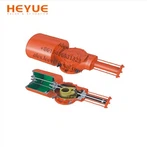
1. Thin film actuator
Diaphragm actuators are commonly used, and they can be used as push devices for general control valves to form pneumatic diaphragm actuators. The signal pressure p of the pneumatic diaphragm actuator acts on the diaphragm, causing it to deform, driving the push rod on the diaphragm to move, displacing the valve core, thereby changing the valve opening. It has a simple structure, is cheap, is easy to maintain and is widely used.
Pneumatic diaphragm actuators come in two forms: direct action and reaction.
When the signal pressure from the controller or valve positioner increases, the downward movement of the valve stem is called a forward-acting actuator; when the signal pressure increases, the upward movement of the valve stem is called a reaction actuator. The signal pressure of the direct-acting actuator is passed into the diaphragm air chamber above the corrugated diaphragm; the signal pressure of the reaction actuator is passed into the diaphragm air chamber below the corrugated diaphragm. By replacing individual parts, the two can be retrofitted into each other.
2. Piston actuator
The pneumatic piston actuator causes the piston to move in the cylinder to generate thrust. Obviously, the output force of the piston type is much greater than that of the diaphragm type. Therefore, the diaphragm type is suitable for occasions with small output and high precision; the piston type is suitable for occasions with large output force, such as large diameter, high pressure drop control or butterfly valve pushing device. In addition to the diaphragm type and piston type, there is also a long-stroke actuator, which has a long stroke and large torque, and is suitable for outputting angular displacement and large torque situations.
The signal standard received by the pneumatic actuator is 0.02 to 0.1MPa.
The main components of pneumatic piston actuator are cylinder, piston and push rod. The piston in the cylinder moves with the change in pressure difference on both sides of the cylinder. According to the characteristics, it is divided into two types: proportional type and two-digit type. According to the input operating pressure on both sides of the piston, the piston is pushed from the high-pressure side to the low-pressure side. The proportional type is based on the two-position type and adds a valve positioner to make the push rod displacement and signal pressure proportional.
3. Rack and pinion actuator
The rack-and-pinion (double-piston rack-and-pinion) pneumatic actuator has the characteristics of compact structure, beautiful appearance, quick response, stable operation, and long service life. All accessories adopt advanced anti-corrosion treatment technology and can adapt to various harsh working conditions. Its high and low temperature and various special stroke actuators have good performance in various application fields.